
LaXing · Financing the Grade Separation Act

What it Costs

Lifting the A, E and K Lines out of street traffic is a $15–25 billion job, delivered over ten years, paid for with money Los Angeles County has already voted to spend on roads and freeways. No new taxes. Here is the math, in plain terms, for the people who will vote on it.

$15–25Btotal cost, depending on inflation and how the work is delivered
10 yearsthe deadline Metro would be given to finish every separation
$9Binitial transfer from roadway & highway projects — the down payment
18–22kjobs supported each year of construction, on site and across the region
How much will it cost?

Roughly $15 to $25 billion

Roughly $15–25 billion, depending on inflation and project delivery methods.
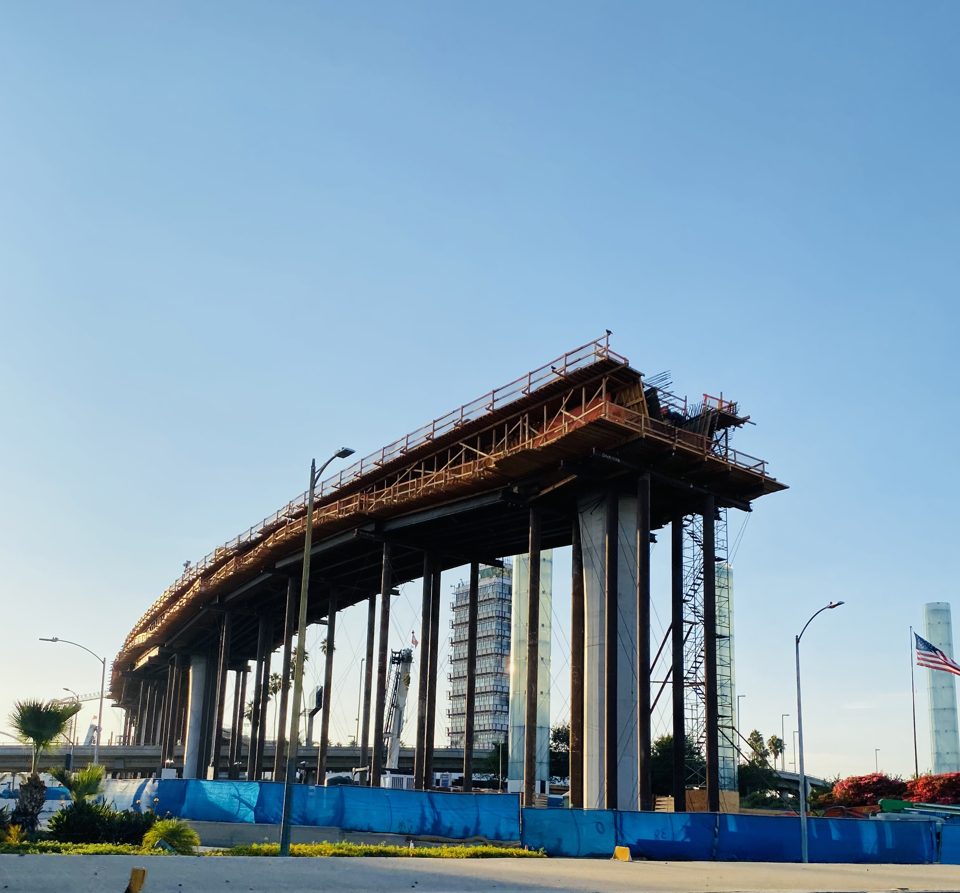
What the money buys: a new K Line bridge being lifted over Sepulveda Boulevard at LAX, October 2021 — one crossing taken out of traffic for good.
What the money buys: a new K Line bridge being lifted over Sepulveda Boulevard at LAX, October 2021 — one crossing taken out of traffic for good. Photo: Polylerus · CC BY-SA 4.0 · Wikimedia Commons

That range covers separating all 223 places where the A, E and K Lines currently cross car traffic at street level — by raising the tracks onto a viaduct, lowering them into a trench, or bridging the road over them — plus the longer platforms that let Metro run 6-car trains. The low end assumes steady prices and fast, bundled contracts; the high end assumes higher inflation and one-crossing-at-a-time delivery.

$1.5–2.5Bper year, spread across the 10-year build
$67–112Maverage per crossing, all 223 included
15–26%of one year of Metro's current $9.7B budget, each year

For scale: Melbourne is doing the same thing right now

223LA crossings to separate
$15–25B · 10 years
vs
110Melbourne crossings being removed
≈ A$15.3B (≈ US$10B) · 2015–2030

Melbourne has already removed 88 of 110 crossings, rebuilt 40 stations, and is on schedule to finish in 2030. Their per-crossing cost lands in the same range as this projection — and voters there have re-elected the program twice.

Sources: Justin Levy, LaXing financial projection (Sept 2026); Victoria's Big Build — Level Crossing Removal Project; Victorian Auditor-General cost estimates. Per-crossing and per-year figures are simple division of the projection range and are illustrative.

Where does the money come from?

From road and freeway funds voters already approved

Initially $9 billion is transferred from roadway projects. Because Measure M has no sunset date, more funding can be allocated when needed, and numerous Federal and State grants can help. In addition to roadway funding, Local Return funds — which often get used for road improvement programs — will also be allocated to this project.
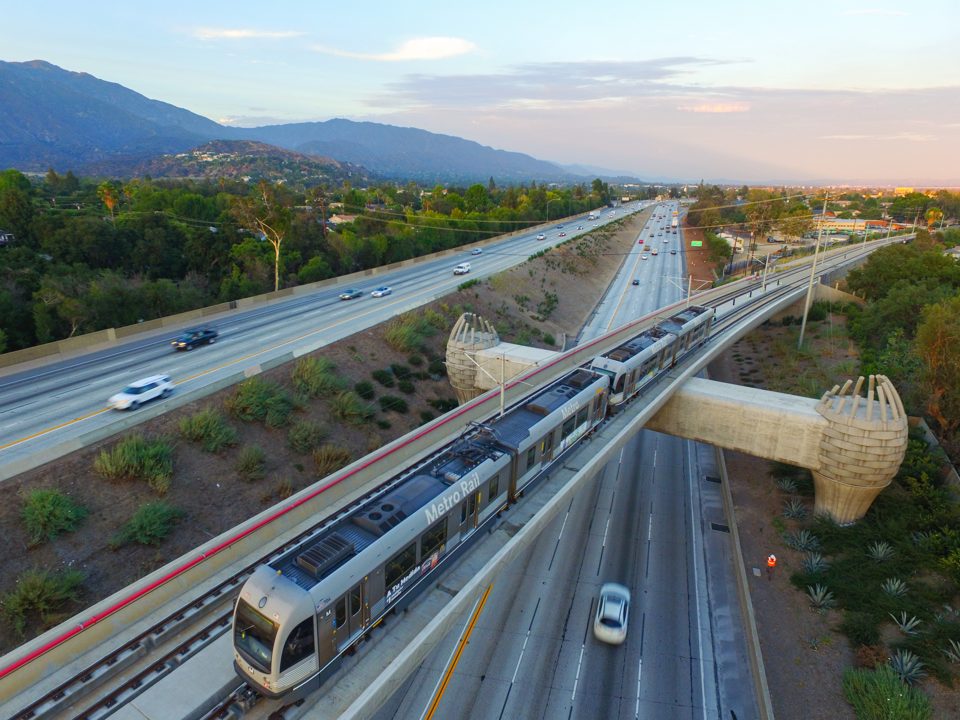
Road money already builds rail over roads: the A Line riding the I-210 median in the San Gabriel Valley, on a bridge paid for with the same county sales-tax measures.
Road money already builds rail over roads: the A Line riding the I-210 median in the San Gabriel Valley, on a bridge paid for with the same county sales-tax measures. Photo: Foothill Gold Line Construction Authority/LACMTA · Public domain · Wikimedia Commons

In plain terms: Los Angeles County already collects two half-cent sales taxes for transportation, Measure R (2008) and Measure M (2016). Both set aside a fixed share for highway construction, and both send a share back to cities as "Local Return," which cities mostly spend repaving streets. The initiative redirects those road dollars into grade separation for ten years. Measure M never expires, so the road programs are paused, not cancelled — they resume once the trains are separated.

$9 billion — initial transfer from roadway & highway projectsMeasure R & Measure M highway construction subfunds. This is the only number in the plan that is fixed up front.
Local ReturnThe 15–17% of each measure that goes back to cities, usually for road work, is directed to the separations in their city.
Federal & State grantsRail-crossing elimination, transit capital and safety grants that LA is eligible for but rarely captures at scale.
Measure M top-up, as neededMeasure M has no sunset, so Metro can borrow against future years to close any gap between $9B and the final price.

The bar shows the order in which sources are drawn on, not exact proportions; only the $9B figure is fixed in the projection. The remaining $6–16B is covered by the other three sources in combination.

What $9 billion of road money looks like

Metro's own budget puts this in perspective. For the fiscal year that started July 2026, Metro plans to spend $887 million widening freeways — up 40% on the year before. Ten years of that single line item is the whole down payment.

$887MMetro's freeway-expansion budget, FY 2026–27
× 10 years ≈ $8.9B
≈
$9Bthe initial transfer to grade separation

Sources: Justin Levy projection; Streetsblog LA, March 20 2026 (Metro FY26–27 Highway Multimodal Program: $157.5M capacity, $340.5M Express/HOV, $335.1M subregional, $46M bus); Metro Measure M (no-sunset half-cent sales tax).

Where does transportation money go today?

Highways still get most of it — at every level of government

The case for redirecting road money rests on a simple fact: roads and freeways already receive the lion's share of transportation dollars flowing into Los Angeles. Four snapshots, federal to local:
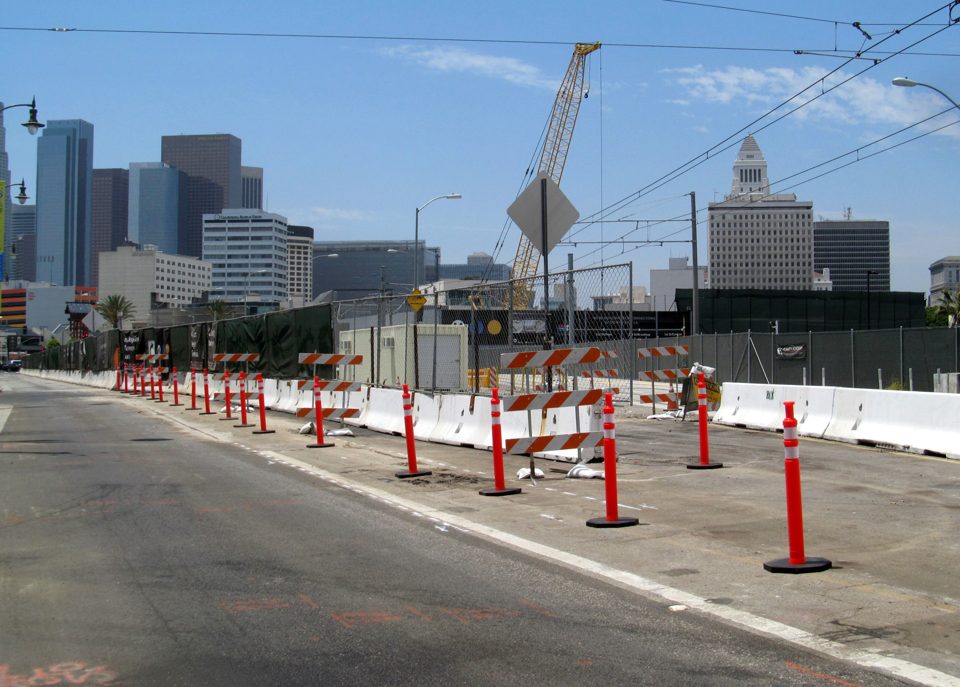
Where road money goes today: cones, barricades and a lane taken for the Regional Connector on East 1st Street, 2017 — the everyday cost of building anything in the street.
Where road money goes today: cones, barricades and a lane taken for the Regional Connector on East 1st Street, 2017 — the everyday cost of building anything in the street. Photo: Pi.1415926535 · CC BY-SA 3.0 · Wikimedia Commons
Highways & roadsMetro & transit
Federal: Infrastructure Investment & Jobs Act dollars to California, 2022–2026
Five-year formula funding, billions of dollars
Highways $25.3B Public transit $9.45B
73 cents of every federal dollar California receives under the 2021 infrastructure law is for highways. Source: Caltrans, IIJA estimates for California.
View as table
Program5-year total
Federal-aid highways$25.3B
Public transit$9.45B
State: California's transportation budget, 2025–26
Selected programs, billions of dollars (one year)
Caltrans $16.1B Local streets & roads $3.7B Transit & rail capital $1.56B State transit aid $1.09B High-speed rail $0.8B
Roads and highways: about $19.8B. Transit and rail: about $3.5B. Source: Legislative Analyst's Office, The 2025–26 California Spending Plan: Transportation ($30.9B total, incl. CHP and DMV, not shown).
View as table
Program2025–26
Caltrans$16.1B
Local streets & roads$3.7B
Transit & Intercity Rail Capital$1.56B
State Transit Assistance$1.09B
High-Speed Rail Authority$0.8B
County: how Measure M divides LA County's half-cent sales tax
Metro's adopted 40-year expenditure plan, FY 2018–2057, billions of dollars (escalated)
Transit construction $41.9B 35% Transit operations $23.9B 20% Highway construction $20.3B 17% Local Return (cities) $19.1B 16% Everything else $16.2B 12%
Measure M does fund a lot of transit — but its highway construction and Local Return subfunds together hold $39B earmarked mostly for roads, and the measure never expires. That is the pool the initiative borrows from. Source: Measure M Ordinance, Attachment A, Expenditure Plan ($121.4B grand total; Local Return shown at its 16% base).
View as table
SubfundShare40-year total
Transit construction35%$41.9B
Transit operations20%$23.9B
Highway construction17%$20.3B
Local Return16%$19.1B
Metro rail ops, good repair, ADA, active transportation, regional rail12%$16.2B
Metro: this year's $9.7 billion budget, FY 2026–27
Largest line items, billions of dollars
Bus & rail operations $3.0B Transit construction $2.0B Pass-through to cities $1.8B Freeway expansion $0.89B ↑ 40% vs last year
Transit construction is shrinking (−7.7%) while freeway widening is growing (+40%) in the same budget. Sources: MyNewsLA, May 28 2026 (board-approved FY26–27 budget); Streetsblog LA, March 2026.
View as table
Line itemFY 2026–27
Bus & rail operations~$3.0B
Transit infrastructure development$2.0B
Regional allocations & pass-through$1.8B
Freeway expansion$0.887B
What changes if the measure passes?

Ten years of road money moves to the rails — then moves back

Metro is given a 10-year time frame to complete the project, and the funding comes from roadway and highway projects.
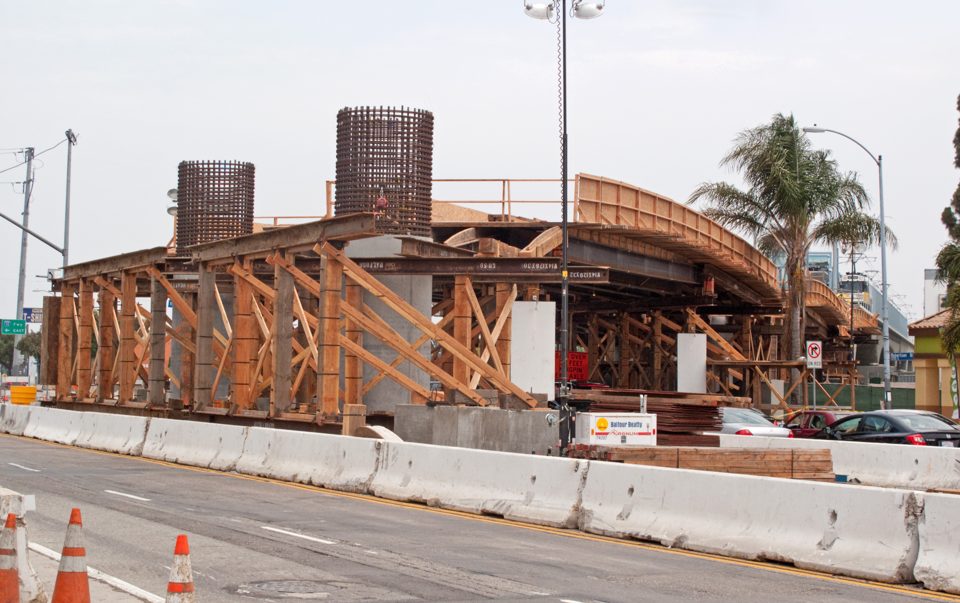
Ten years of building: falsework for the E Line’s elevated Culver City station, 2013 — the kind of structure that lifts a line clear of the street.
Ten years of building: falsework for the E Line’s elevated Culver City station, 2013 — the kind of structure that lifts a line clear of the street. Photo: Downtowngal · CC BY-SA 3.0 · Wikimedia Commons

Nothing about the taxes changes. What changes is the order of the queue: for one decade, the highway construction and Local Return dollars that would have widened freeways and repaved streets are spent lifting the trains out of traffic first. Because Measure M has no end date, the road programs pick up again afterwards — with faster trains carrying more of the people who used to be stuck in the same traffic.

Today 2028 ballot 2033 2038 deadline 2039 → Roads &freeways Gradeseparation $887M / yr paused — redirected to separation resumes (no sunset) $0 today $1.5–2.5B / yr $9B roadway transfer + Local Return + grants 223 crossings gone · 6-car trains
Today
Roads & freeways$887M / yr
Grade separation$0
2028 ballot → 2038 deadline
Roads & freewayspaused — redirected
Grade separation$1.5–2.5B / yr
$9B roadway transfer + Local Return + grants
2039 →
Roads & freewaysresume (no sunset)
Grade separation223 crossings gone · 6-car trains

Illustrative. Today's roads figure is Metro's FY 2026–27 freeway-expansion budget; the per-year separation figure is the $15–25B projection divided over ten years. The 2028 ballot and 10-year deadline come from the draft LA County Safe and Efficient Light Rail Grade Separation Act.

Why it does not need a new tax: the money is already being collected and already earmarked for transportation. The measure changes what gets built first, not how much you pay.
How many jobs will this create?

Roughly 18,000 to 22,000 jobs a year, for ten years

Using a standard RIMS II distribution for heavy civil construction in urban Los Angeles County:
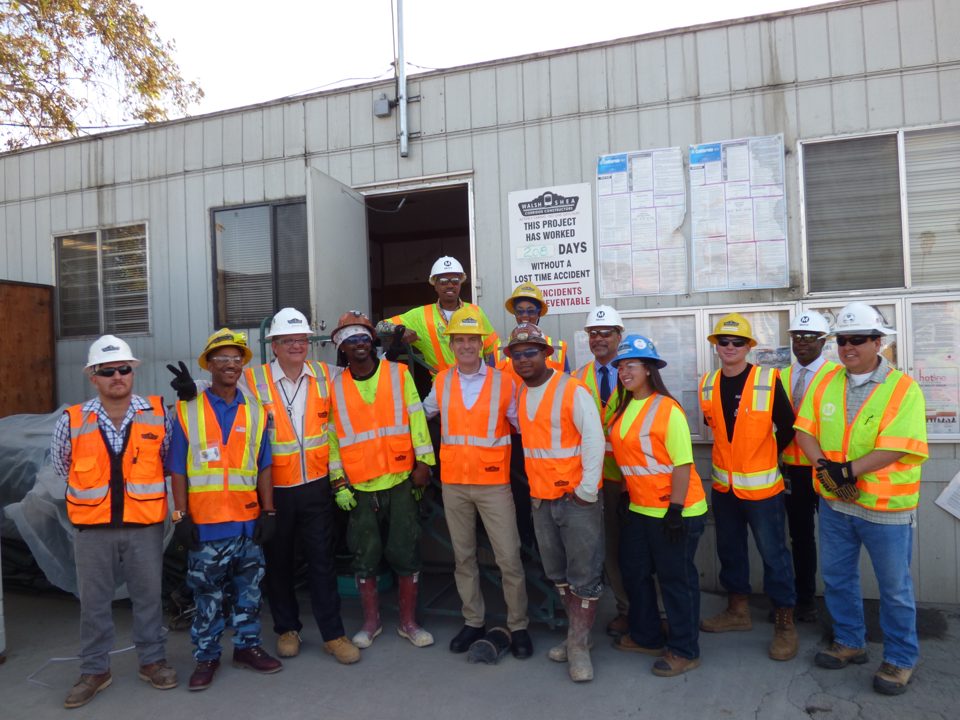
The jobs are real people: the crew building the Crenshaw/LAX line, then the largest public works project in the county, October 2015.
The jobs are real people: the crew building the Crenshaw/LAX line, then the largest public works project in the county, October 2015. Photo: Eric Garcetti · CC BY 2.0 · Wikimedia Commons
8,000–10,000Direct jobs (~40–50%) — annual jobs on site: construction workers, civil engineers, project supervisors, equipment operators
5,000–6,000Indirect jobs (~25–30%) — supported across local supply chains: concrete batch plants, steel fabrication, legal, architecture, equipment leasing
5,000–6,000Induced jobs (~25–30%) — supported when direct and indirect workers spend their paychecks in the LA economy: housing, retail, restaurants, healthcare
Share of annual jobs by type (midpoint of each range)
Direct · 45% Indirect · 27.5% Induced · 27.5%
"Annual jobs" means one full-time job for one year, so a ten-year build supports these numbers every year of construction. RIMS II is the U.S. Bureau of Economic Analysis's standard regional input-output model used by public agencies for exactly this kind of estimate.

Source: Justin Levy, LaXing financial projection (Sept 2026), applying RIMS II multipliers for heavy civil construction in Los Angeles County.

The other questions people ask

Quick answers

Will it cause disruptions?
Very little.

Separations are built alongside or above running tracks, one corridor at a time — the same way the E Line's existing bridges were built. Melbourne kept its trains running through 88 removals.

How much faster will trains be?
Up to 20 minutes back.

Red-light delays alone add up to about 20 minutes on a street-running trip today, on top of the slow zones and stop-and-go that come with sharing pavement. Long Beach to downtown falls from 57 minutes toward 30.

Is this a new tax?
No.

Measure R and Measure M are already on the books. The initiative re-sequences how their road and Local Return dollars are spent for ten years.

What happens to road projects?
They wait, then resume.

Measure M has no sunset date, so highway and street programs restart after the separations are finished — and Metro can borrow against future years if the build runs over $9B.
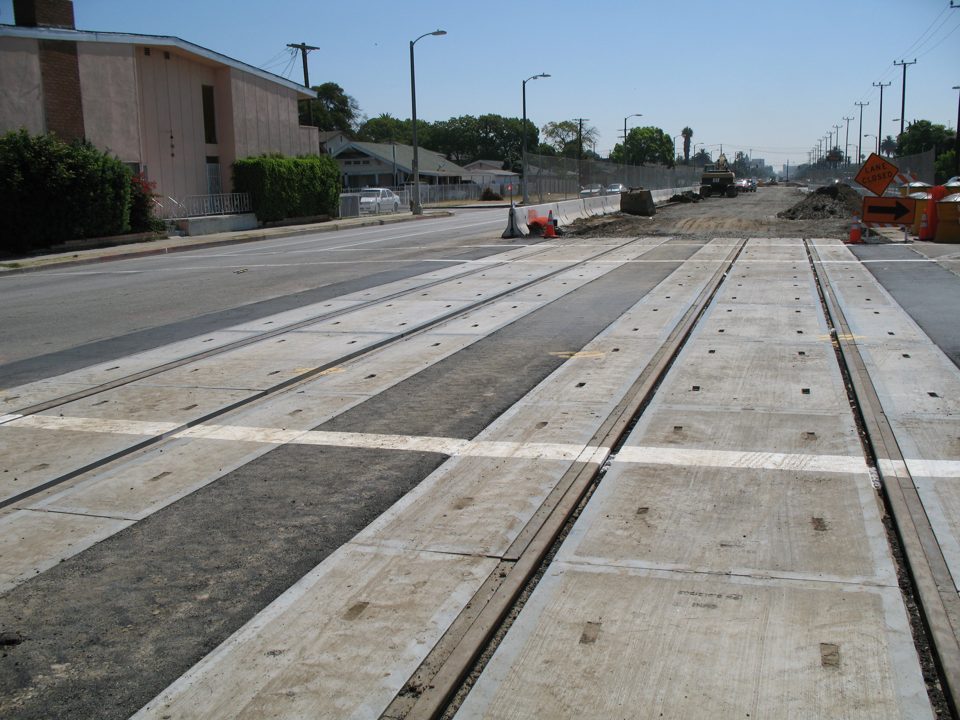
First rails: the Expo Line’s first tracks laid in the street at Exposition and Denker, 2008.
First rails: the Expo Line’s first tracks laid in the street at Exposition and Denker, 2008. Photo: Support the ballot initiative ← Back to the Story Map See all 223 crossings
↑ Back to top